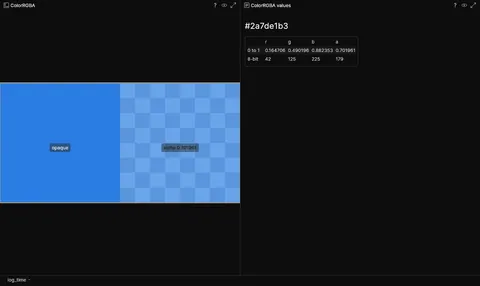
ColorRGBA
A swatch of the colour, opaque beside how it draws at its alpha over a checker, with its hex and channel values.
Rerun 0.40.0 · robot_msgs
import robot_msg_viz as viz

viz.show(pose)               # open its stock view
viz.save("pose.rrd", pose)   # a file, layout inside
with viz.stream("arm") as live:
live.log(joint_state) # live, as they arriverobot_msgs.std · 4 of 5 with a view
A swatch of the colour, opaque beside how it draws at its alpha over a checker, with its hex and channel values.
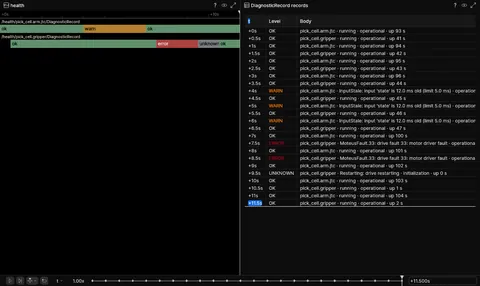
One health lane per component (ok, warn, error, unknown over time) above the records themselves as a log.
No stock view yet: show() draws its repr as text.
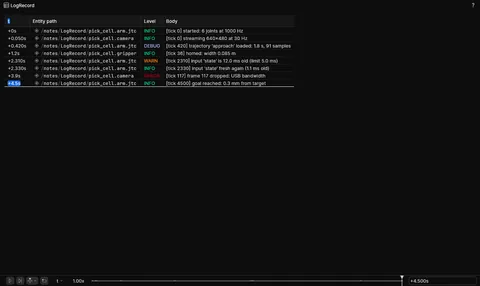
Rerun's text log: one row per record (time, component, level, tick and message), warnings and errors coloured.
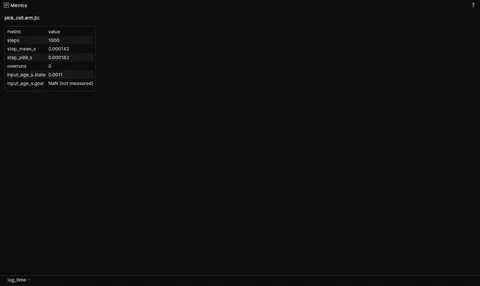
The component's named numbers as a table (NaN spelled out as not measured); each is also a scalar series.
robot_msgs.geometry · 12 of 12 with a view
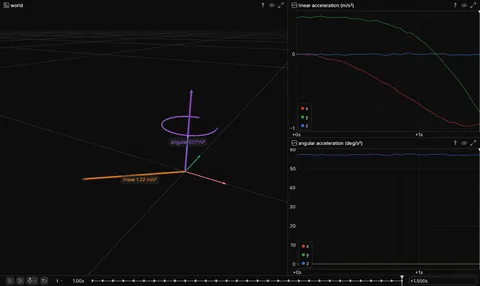
Linear (orange) and angular (purple) acceleration arrows, and both over time; angular in deg/s².
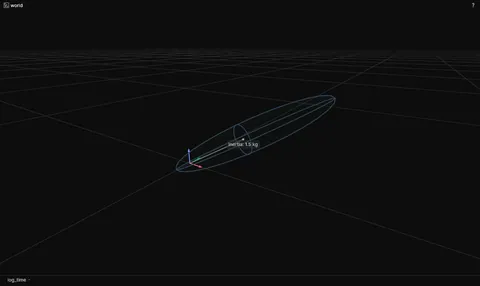
The equivalent inertia ellipsoid (same mass and moments) at the centre of mass, labelled with the mass.
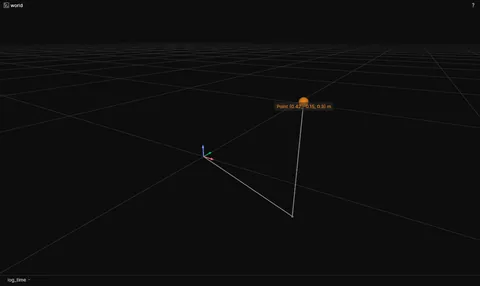
A marker at the position labelled with its coordinates, with a drop line to the floor and a line home.
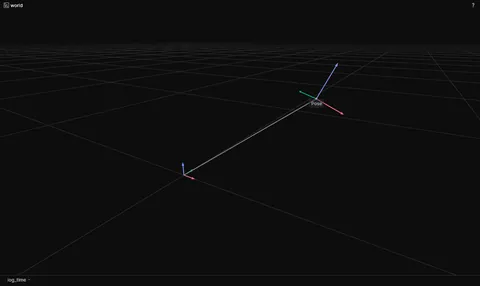
A coordinate frame: red, green, blue axes (x, y, z) at the position, turned by the orientation.
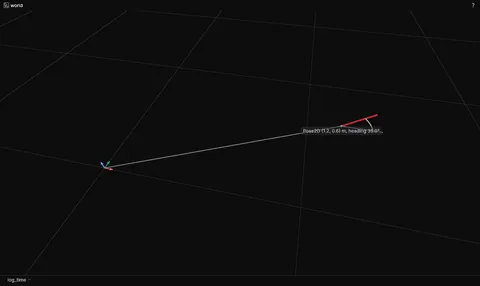
A position on the floor with a heading arrow, the arc from +x to it, and the heading in degrees.
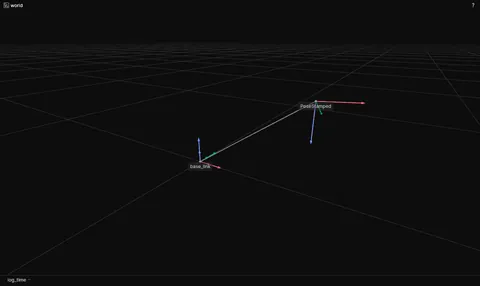
A named coordinate frame linked to its parent frame (header.frame_id), drawn and named at the origin.
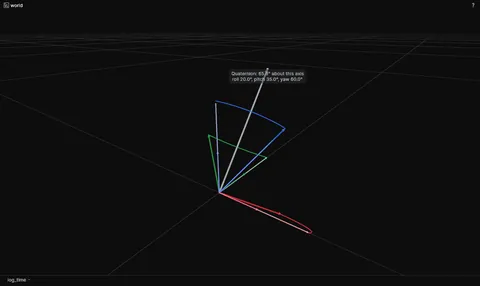
The turn: a faint triad before, the bold one after, the arcs between, the axis and its angle in degrees.
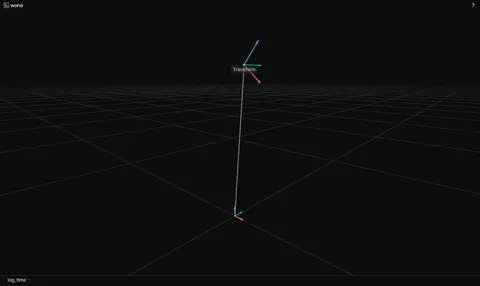
Where a child frame sits in its parent: the child's axes, and a line back to the parent's origin.
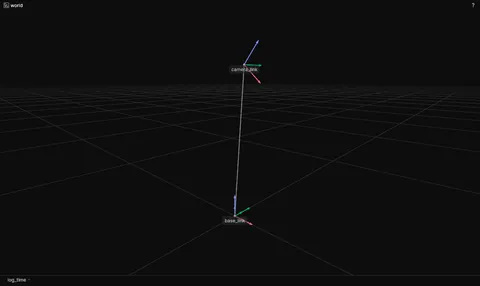
One edge of the transform tree: parent and child frames, each named, joined by a line.
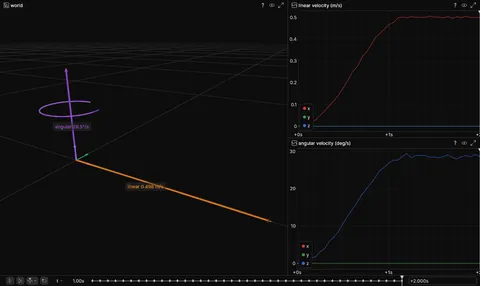
Linear (orange) and angular (purple, with its spin) velocity arrows, and both over time (angular in deg/s).
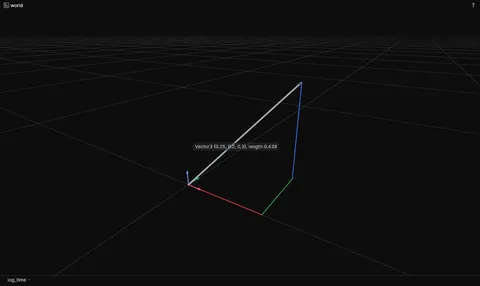
An arrow from the origin with its components and length, and its x, y, z steps in red, green, blue.
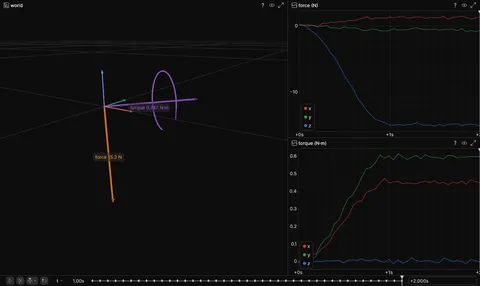
Force (orange) and torque (purple, with its twist) arrows at the sensor, and both over time.
robot_msgs.shape · 3 of 4 with a view
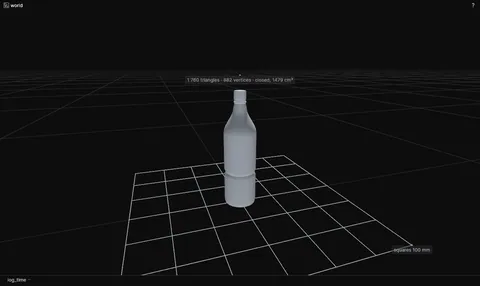
The shaded triangle mesh, with its triangle and vertex counts (and volume, when it is closed) as a label.
No stock view yet: show() draws its repr as text.
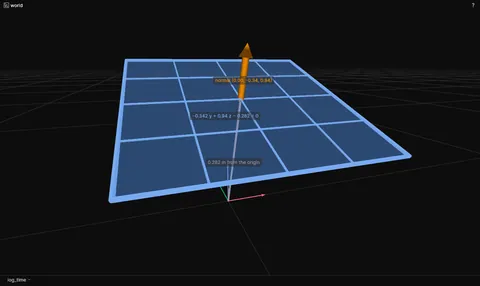
A translucent patch of the (infinite) plane around its point nearest the origin, its normal arrow and its equation.
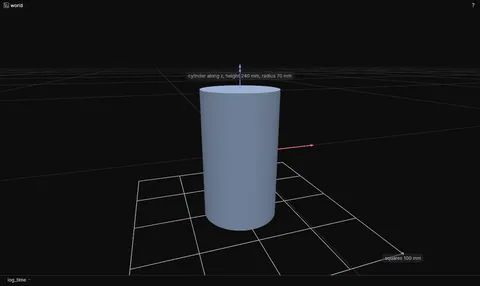
The shaded solid centred on its own frame (red, green, blue axes), its kind and size in mm as a label.
robot_msgs.sensor · 5 of 6 with a view
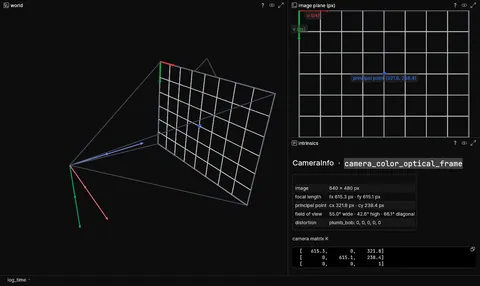
The camera's view cone (pinhole frustum) with its pixel grid and principal point, and the intrinsics (size, focal length, field of view in degrees, distortion) as a table.
No stock view yet: show() draws its repr as text.
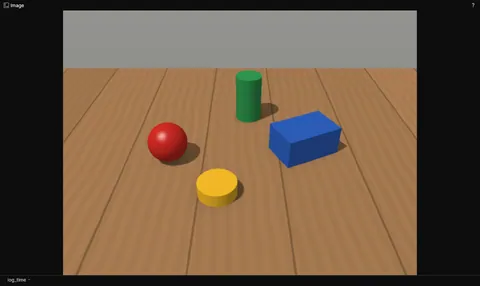
The picture as the camera took it; a depth image is coloured by distance (Turbo).
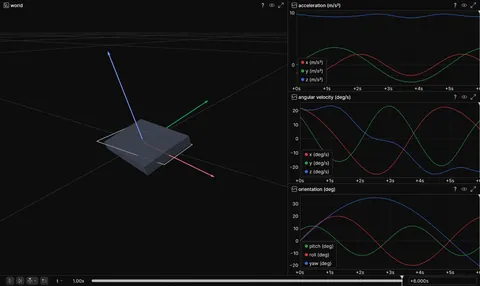
Acceleration (m/s²), angular velocity (deg/s) and roll/pitch/yaw (deg) over time, x/y/z in red/green/blue, and the sensor's orientation as a turning frame in 3D.
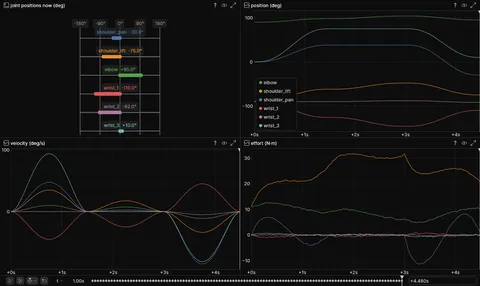
Each joint's position (deg), velocity (deg/s) and effort over time, one colour per joint, and a labelled bar per joint showing where it is now.
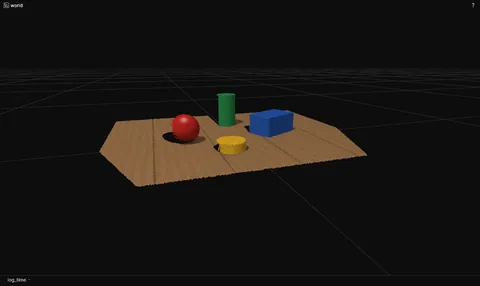
The points in 3D, coloured by their rgb channel, else by intensity, else by height.
robot_msgs.vision · 8 of 8 with a view
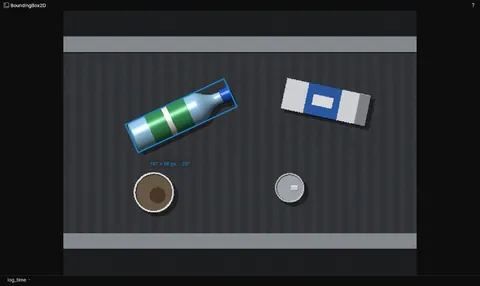
A rectangle on the image, drawn rotated when it is, labelled with its size in pixels (and its angle).
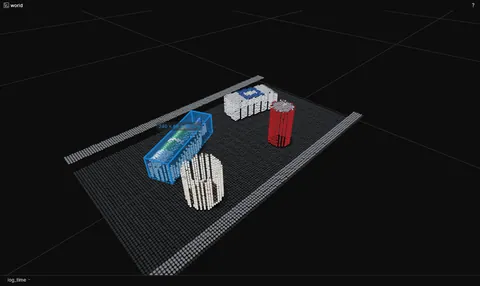
An oriented box in the 3D scene, labelled with its size in millimetres.
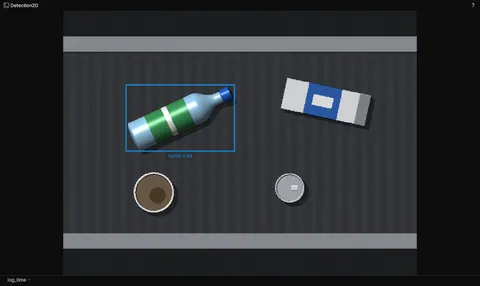
One detected object: its box on the image in its class colour, labelled with its best class and score.
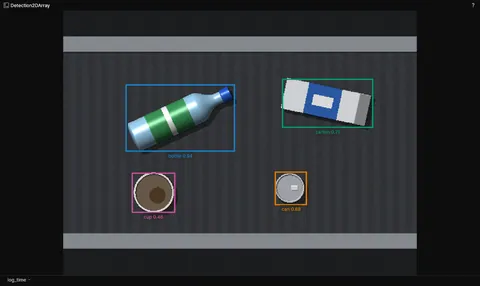
Every detection in one image: a box per object, one colour per class, each labelled with class and score.
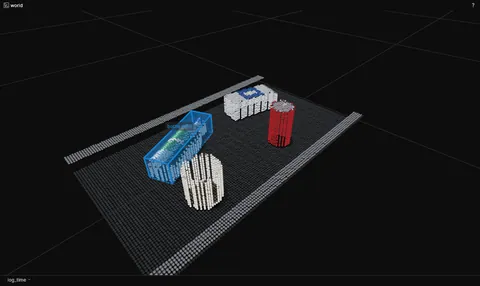
One detected object in 3D: its oriented box in its class colour, labelled with its best class and score.
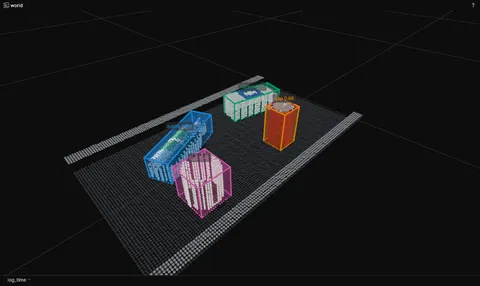
Every detection in one frame: an oriented box per object, one colour per class, each labelled with class and score.
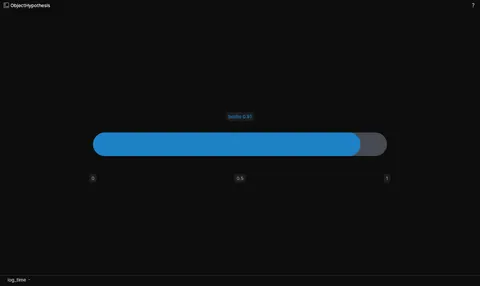
A class guess: a bar filled to its score on a 0-1 track, brighter when more confident, named by class.
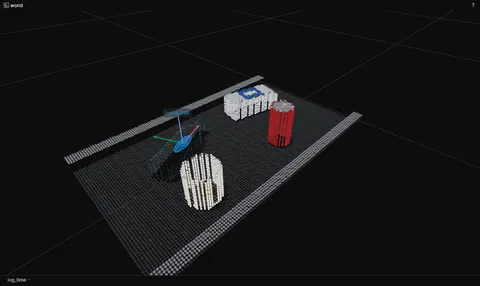
A class guess with a pose: a frame at the object labelled with class and score, inside its 1σ position ellipsoid.
robot_msgs.trajectory · 18 of 18 with a view
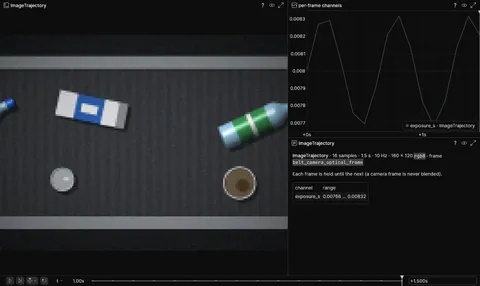
A camera stream: the frames on the timeline (scrub or play it), beside the per-frame channels (exposure, a score) and the stream's size, rate and encoding.
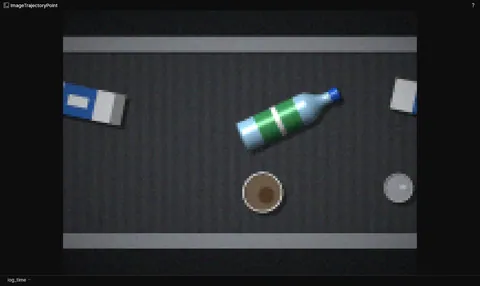
One frame of a camera stream, drawn as an Image.
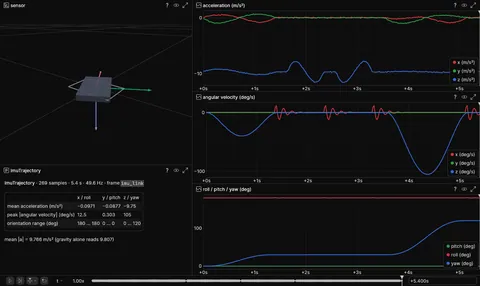
An IMU log: the sensor board turning in 3D on the timeline, beside acceleration (m/s²), angular velocity (deg/s) and roll / pitch / yaw (deg) over time, x/y/z in red/green/blue.
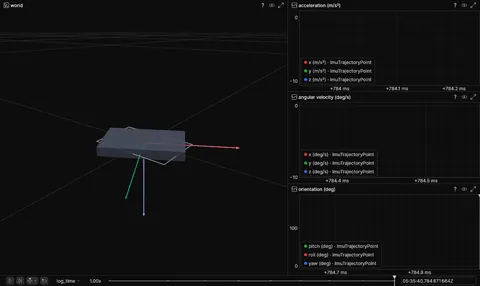
One IMU sample, drawn as an Imu: the board turned by its orientation, its rates and acceleration.
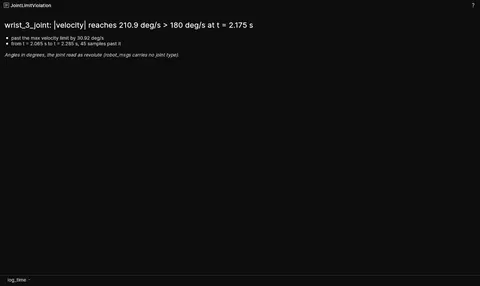
The violation as one sentence in degrees: which joint, which bound, how far past it, when and for how long.
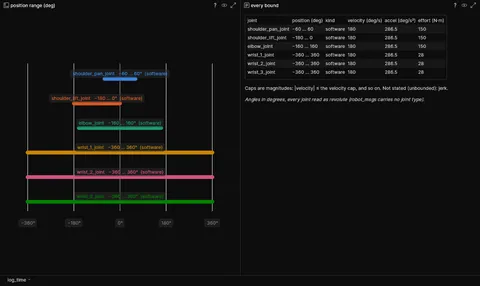
Each joint's position range as a bar on one degree scale, beside a table of every bound: the range and its kind, and the velocity, acceleration, jerk and effort caps.
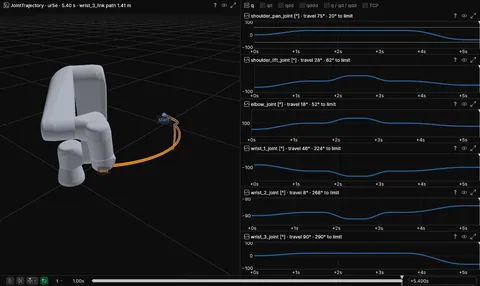
V1, the stock trajectory viewer: the URDF arm moving on the left, tabs on the right: q, qd, qdd, qddd (a strip per joint in degrees with its limits), q / qd / qdd (% of each joint's limits) and TCP. No URDF: the same tabs at full width.
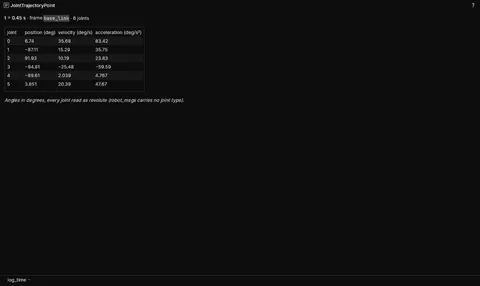
A table of one sample: each joint's position, velocity and acceleration in degrees, at its instant t.
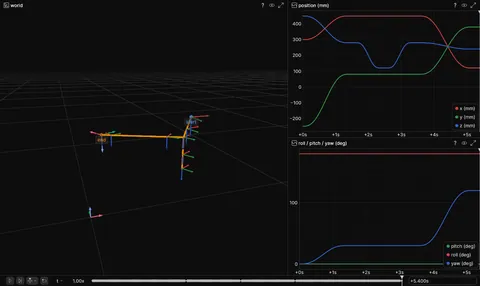
The path in 3D with x/y/z frames along it and one moving with the timeline, beside its position (mm) and roll / pitch / yaw (deg) over time.
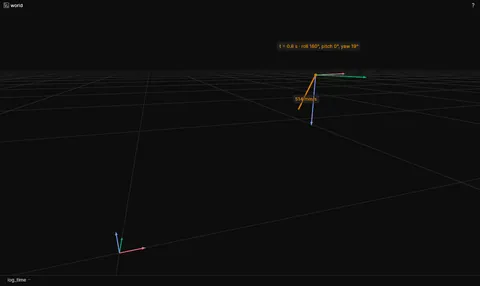
One sample of a pose trajectory: its x/y/z frame, its time and orientation, and its velocity arrow.
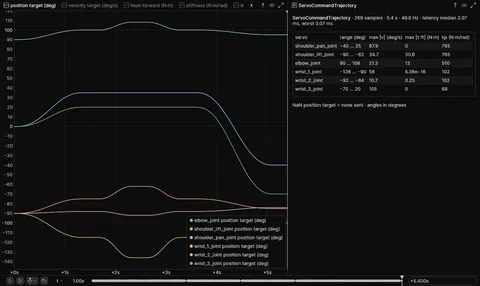
What the controller sent: position and velocity targets (deg, deg/s), feed-forward, stiffness, damping and effort cap per servo over time, and each command's latency (ms).
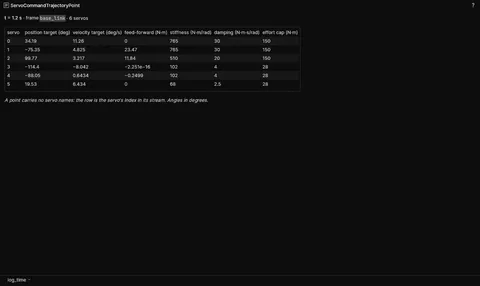
One command as a table: each servo's position and velocity target (deg, deg/s), feed-forward, gains and effort cap.
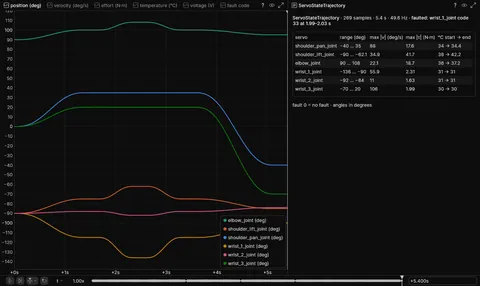
A drive log: each servo's position (deg), velocity (deg/s), effort (N·m), temperature (°C), voltage (V) and fault code over time, one tab each, beside its range, peaks and faults per servo.
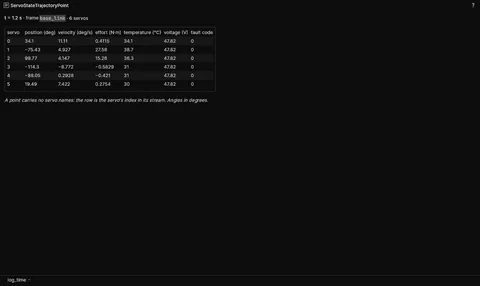
One sample of a drive log as a table: each servo's position (deg), velocity, effort, temperature, voltage and fault code.
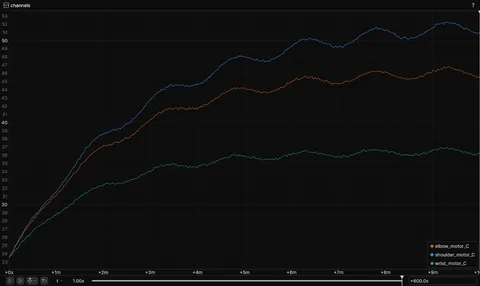
Every channel over time in one plot, one line per channel, the legend naming it.
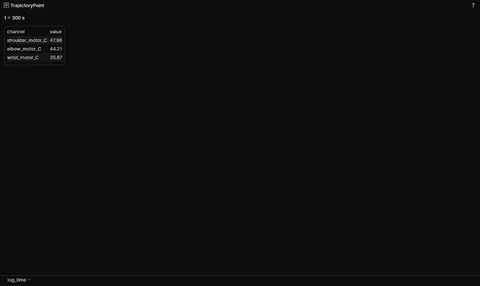
A table of the sample's channel values at its instant t.
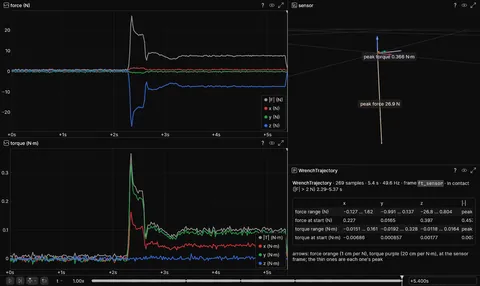
An F/T sensor log: force (N) and torque (N·m) over time, x/y/z in red/green/blue with the magnitude in grey, the two arrows at the sensor on the timeline, and when it was in contact.
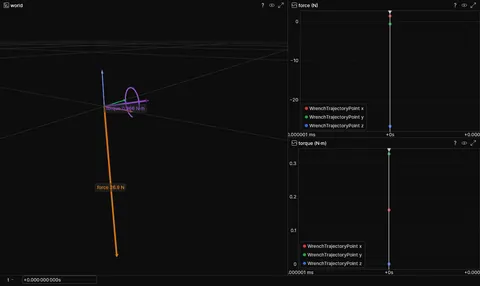
One F/T sample, drawn as a Wrench: the force and torque arrows at the sensor, with their values.
robot_msgs.control · 4 of 10 with a view
No stock view yet: show() draws its repr as text.
No stock view yet: show() draws its repr as text.
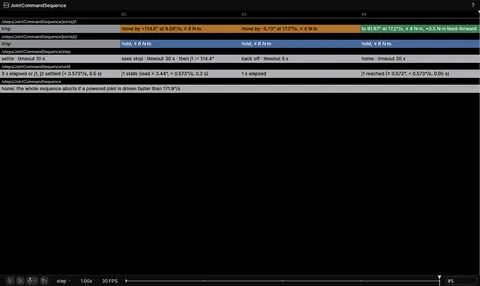
The routine as lanes over its steps, in order: what each joint does (coloured limp, hold, move by, move to), when each step ends and its timeout, and the speed guard over all of it.
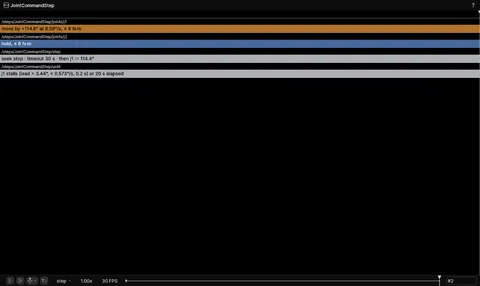
One step as lanes: what each joint it names does (coloured by mode) and when the step ends.
No stock view yet: show() draws its repr as text.
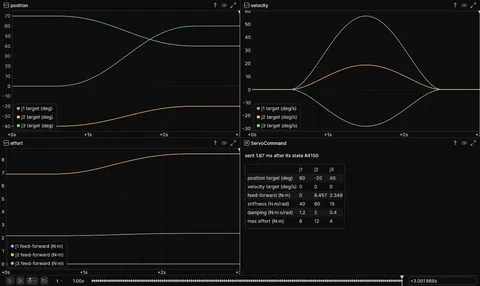
Per-servo position and velocity targets (deg, deg/s) and feed-forward effort (N·m) over time, and a table of targets, gains, caps and latency at the playhead.
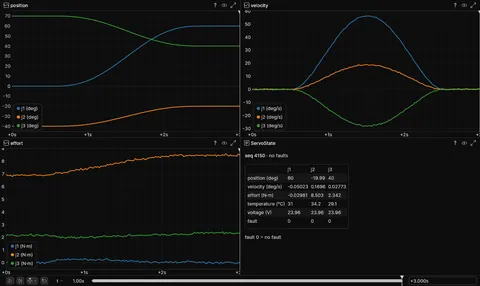
Per-servo position (deg), velocity (deg/s) and effort (N·m) over time, and a table of every field (temperature, voltage, fault too) at the playhead.
No stock view yet: show() draws its repr as text.
No stock view yet: show() draws its repr as text.
No stock view yet: show() draws its repr as text.
robot_msgs.manipulation · 7 of 8 with a view
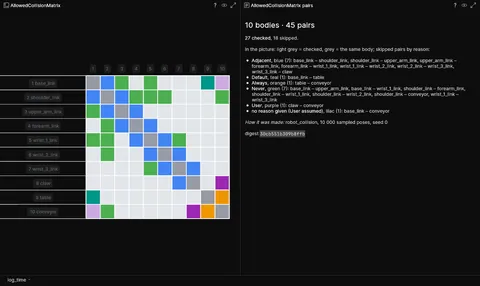
The matrix as a picture, each skipped pair coloured by its reason (hover a cell for it), and a card listing the pairs.
No stock view yet: show() draws its repr as text.
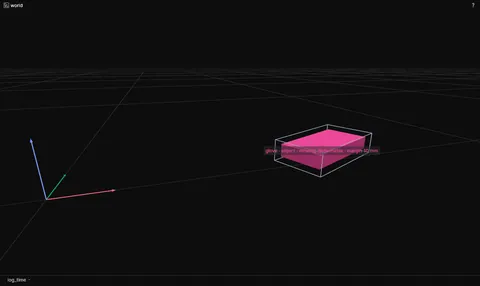
The element's shapes, shaded in its motion/compliance colour, its margin as a faint outline; source and tags in the label.
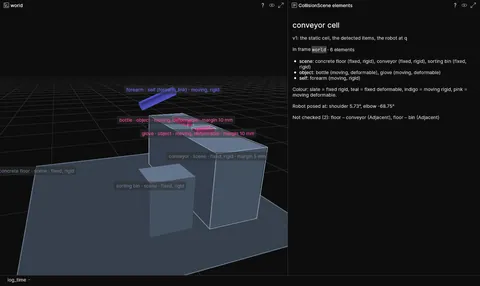
Every collision element coloured by motion and compliance, labelled, beside a card of the elements, the robot state in degrees and the ACM.
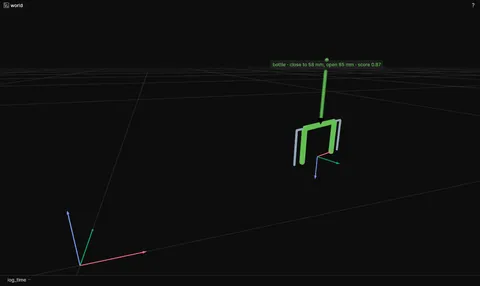
A two-finger gripper at the grasp: closing width solid, open width faint, approach arrow into the palm, coloured by score.
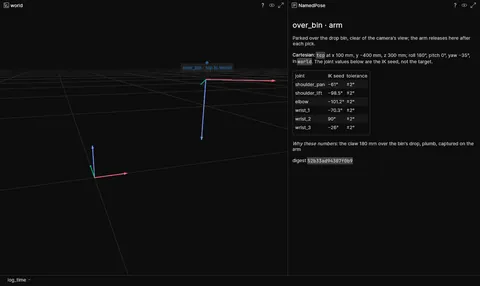
A card with the saved pose's joints in degrees, tolerance and reason; a Cartesian pose also draws its tool frame.
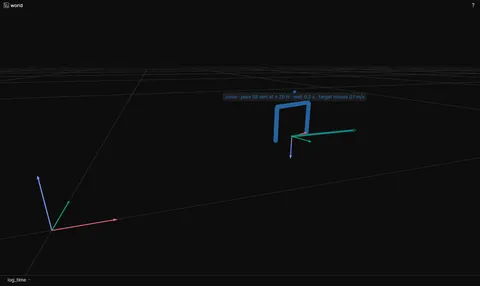
The tool frame at the waypoint, its jaws when it sets a width and the moving target's velocity, with one label.
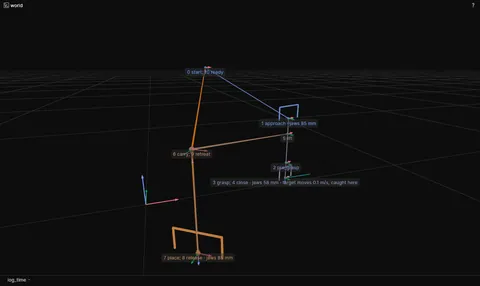
The tool path in order (blue start to orange end) with a small frame, the jaws and a numbered label at each waypoint.
robot_msgs.compare · 9 of 15 with a view
No stock view yet: show() draws its repr as text.
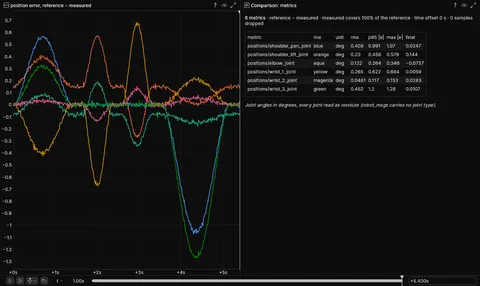
The error (reference − measured) over time, one line per joint in degrees (a pose: x/y/z in mm; a servo, IMU or F/T stream: each field in its unit; a camera: the error frames as a heat map; a point cloud: the points coloured by distance in mm), beside its metrics: rms, p95, max and final.
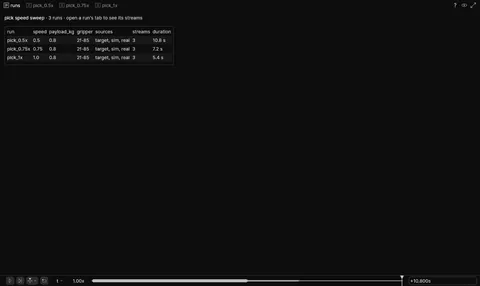
Many runs: a table of the runs and their tags first, then a tab per run that opens its streams, every source overlaid.
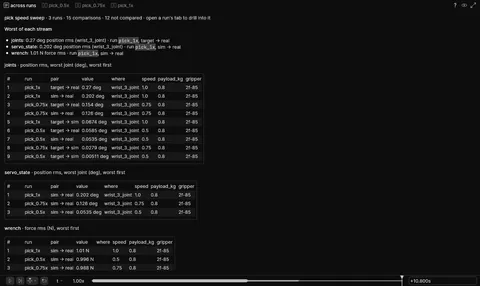
Many runs compared: the worst of each stream first, then per stream a table of runs × pairs ranked worst first with the runs' tags; a tab per run opens its comparisons.
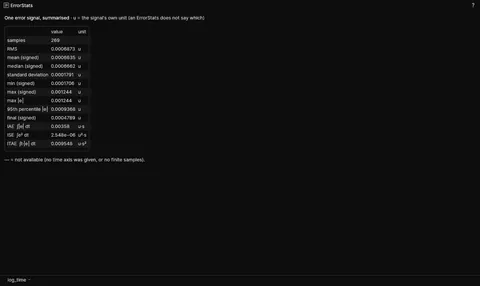
The numbers of one error signal as a table: RMS, mean, median, spread, worst, p95, final and the integrals.
No stock view yet: show() draws its repr as text.
No stock view yet: show() draws its repr as text.
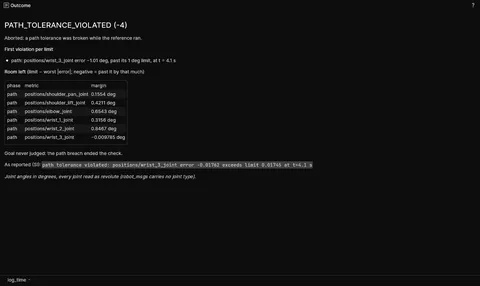
The verdict: the result code in plain words, the first violation of each limit, and the room left under every tolerance, in degrees.
No stock view yet: show() draws its repr as text.
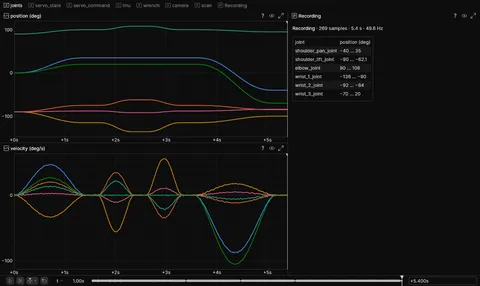
One source's recorded streams, a tab each in its own view (servo, IMU, F/T, camera, joints), and a table of what it recorded and for how long.
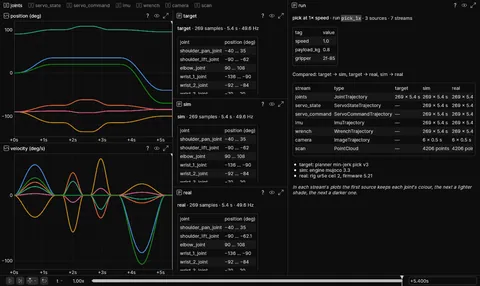
One run: a tab per stream with every source overlaid (target, sim, real), beside its tags, the pairs it compares and what each source recorded.
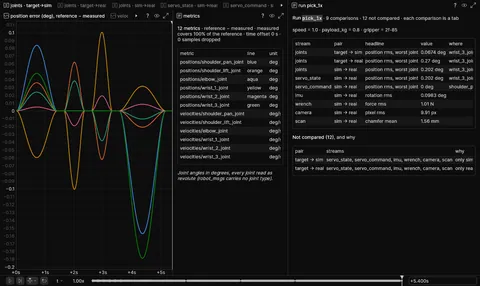
One run compared: a summary of every pair × stream with its headline error (worst joint in degrees, force in N, …) and what was not compared and why, beside a tab per comparison with its error plots.
No stock view yet: show() draws its repr as text.
No stock view yet: show() draws its repr as text.
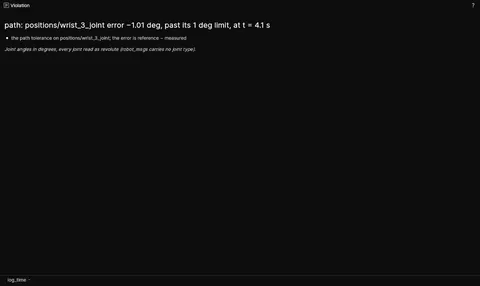
One broken tolerance as a sentence: which limit, the error and the limit in degrees, and when.
robot_msgs.fiducial · 8 of 8 with a view
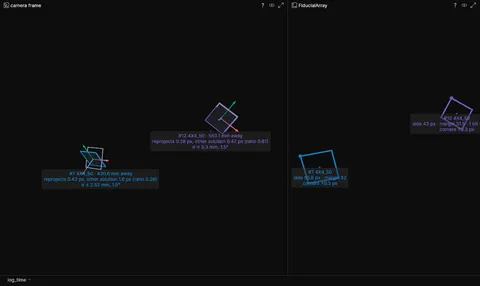
One image's markers: outlines on the image beside their poses in front of the camera, one colour per id.
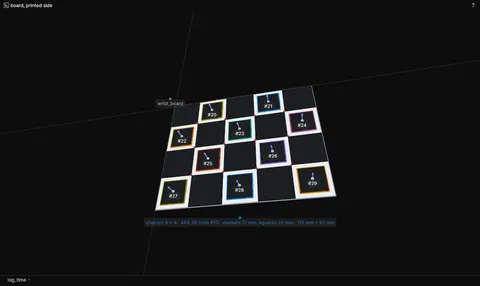
The board as printed: white plate, chessboard squares, marker squares with their ids, ChArUco corners; sizes in mm.
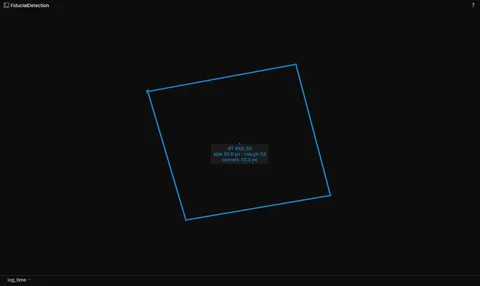
The marker's outline on the image in its id's colour, the top-left corner bigger, labelled with id, side in px and decoder margin.
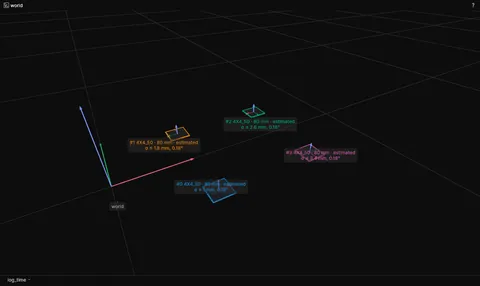
Every mounted marker on its frame: dark squares of their true size, ids and provenance labelled, 1-sigma ellipsoids.
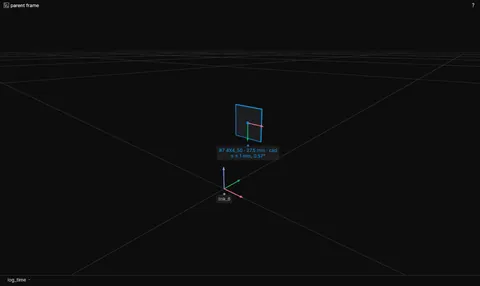
A marker square on its parent frame (labelled), its axes and 1-sigma ellipsoid, with where the mount came from.
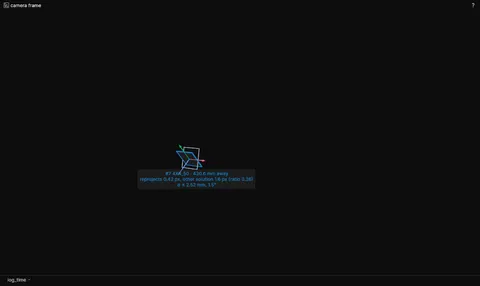
The marker as a dark square in front of the camera, its axes, the other planar solution faint, its 1-sigma ellipsoid; reprojection errors in the label.
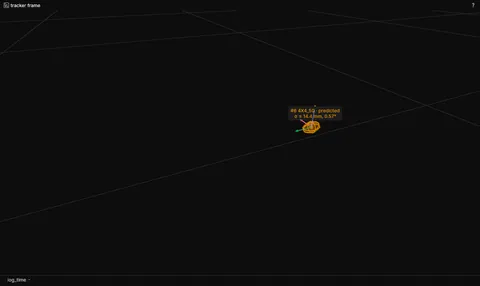
A tracked marker's frame, green when observed this frame and amber when predicted, with its 1-sigma ellipsoid and NIS.
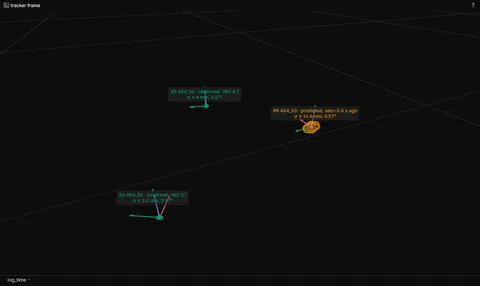
Every tracked marker in the tracker's frame: observed green, predicted amber with time since seen, 1-sigma ellipsoids.
No type matches.
Preconfigured dashboards for a whole job: several robot_msgs types in one Rerun layout, each with sample data.
3 dashboards
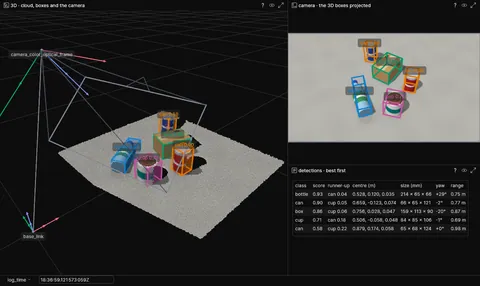
Where are the objects in 3D, and what are they? The cloud with a class-coloured box per detection and the camera's frustum, the boxes projected onto the camera's image, and each detection's numbers.
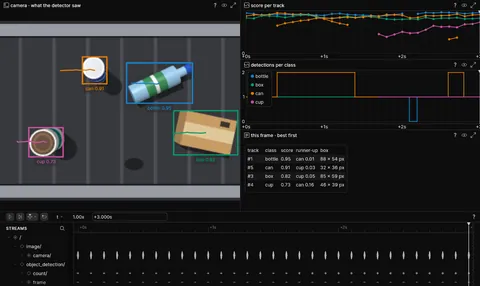
What did the detector see in each frame, and how sure was it over time? The frame with its class-coloured boxes, score per track, detections per class, and this frame's detections as numbers.
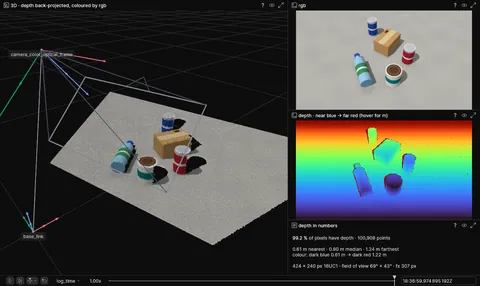
What does the RGB-D camera see, in 2D and in 3D? The depth back-projected into a cloud coloured by the rgb, beside the rgb and depth pictures and how much of the picture has depth.
2 dashboards
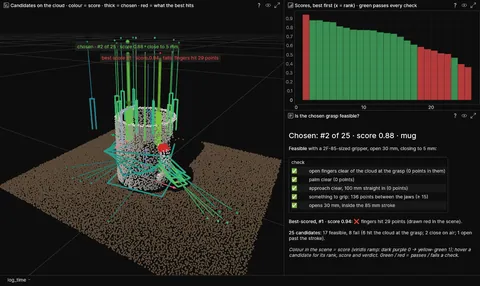
Which grasps did the planner propose on this object, which is best, and is it feasible?
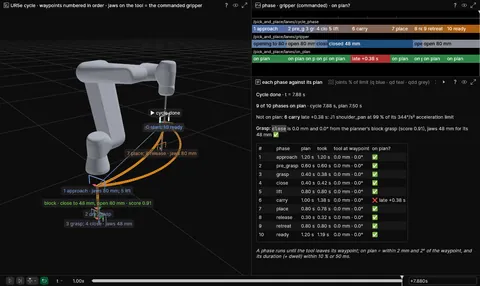
Where is the arm in the pick-and-place cycle, and did each phase go as planned?
JointTrajectoryPoseTrajectoryWaypointActionWaypointGraspPose
1 dashboard
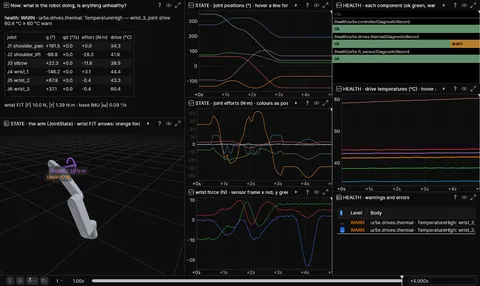
What is the robot doing right now, and is anything unhealthy? A live page: the URDF arm moved by the JointState with its wrist wrench, the joints, efforts and base IMU over time, and apart from them the health: a lane per component, drive temperatures and the warnings.
1 dashboard
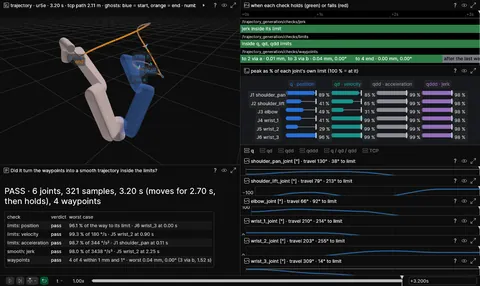
Did the generator turn these waypoints into a smooth trajectory inside the limits? The arm on its path through the numbered waypoints, a pass/fail verdict per check (limits, jerk, waypoints) with its worst case and when it holds, and each joint's peak as % of its limit.